“What it is and how it works.”
Front page picture and contents of leaflet from the National Association for the Prevention of Tuberculosis, c.1949. This leaflet was in my dad’s possession still, when I collected his drawings, belongings, etc., after his death in 2001.
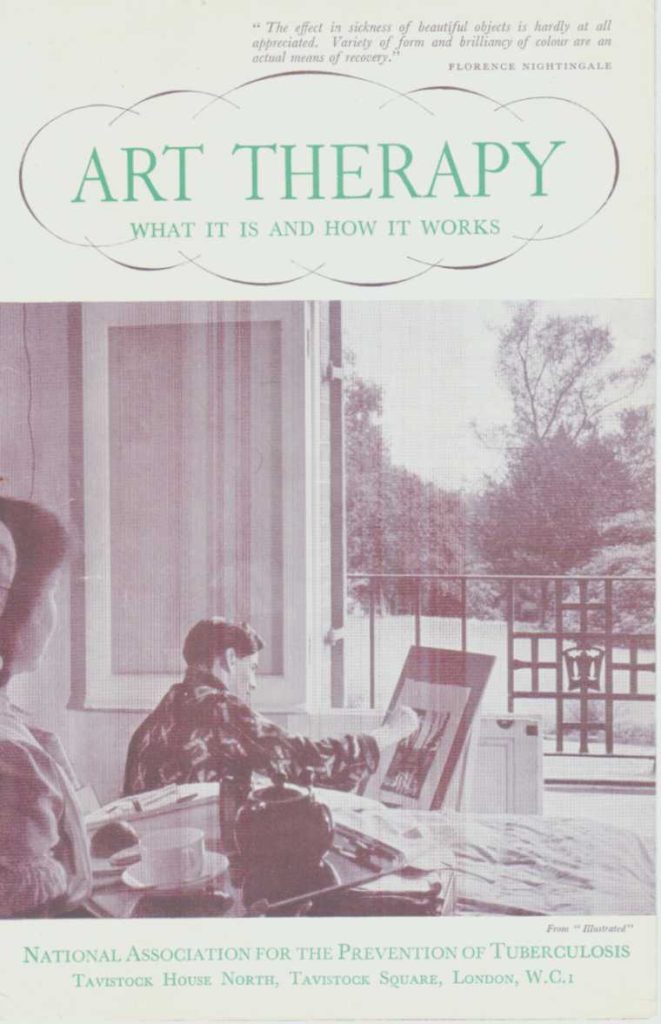
I thought I'd add the contents of this leaflet to give some indication of the "What & How" that the National Association believed in, and which obviously influenced my dad and his carers.
Note that the tuberculosis patient is always referred to as "he"...
What is Art Therapy?
Think of lying in bed for several months at a time, not always feeling actually ill or in pain, but mostly resting monotonously, being an “invalid”, surrounded by medicines, fussy friends, and other sick people, cut off from much of the joy of living. Can that be “life”? Would it not be better just to finish altogether? Adrian Hill, the painter, thought otherwise. During his illness he turned with relief and hope to his picture making. That, he says, was the beginning of Art Therapy, as he calls it, in 1938.
For many such patients suffering from tuberculosis, with similar thoughts, ART THERAPY he found was a life-line. By it a patient can escape boredom, become interested in what is greater than the eternal self he knows so well, and even, with luck achieve something worth while.
Can he become an artist ? That depends on what there is in his imagination. But even though real artists are rare, nearly everyone who is gifted with curiosity can gain immense pleasure. And perhaps healing and fulfilment as well. Certainly his health will benefit, and ART THERAPY (or curing) is correctly named, for it may contribute a definite factor in the long and tedious process of arresting the disease. Its influence penetrates deep. Art can get to places in the human organism beyond the reach of medicines, beyond X-rays.
A tuberculous patient, however courageous, however lucky, has to brace himself for months of idleness and anxiety. When forced to be alone for long periods he has only his other self as his sole companion, and that is not always very congenial.
Art provides a creative occupation he can give that other self, and with some professional help he can learn to use the pencil and paint brush to achieve something he can see and treasure. Not, perhaps, a great masterpiece, but what is important to him “his own work”. It is not necessary that what he does while in bed should be a Royal Academy painting. But ART THERAPY can show him how to release himself.
His fumbling efforts can be made easier, and his haven of self-expression will grow if there is a teacher to inspire and encourage. Someone who will not laugh at his failures, who will show him how to put down what he sees, what he remembers, and how to squeeze out of the depths of his personality what nature has put there, and has perhaps yearned to come forth.
ART can release bottled-up energy. It can purge away emotions that have to do with depression, pessimism and illness. This applies not only to the period of active treatment but also to convalescence.
ART can be curative. Definitely so for some individuals. It is a form of treatment.
The NAPT Art Therapy Scheme is now carried out in seventy sanatoria through Britain. It follows a plan which has been tested and improved through practical experience.
- Competitions are held to find out those who are interested and to inspire them with an idea of what is possible.
- Drawings and paintings are judged by experts and an individual policy laid down for each patient who decides to go on with the idea.
- Expert tuition, direct or by post, is given to enable the patient’s natural gift to be brought out by those who have studied the potentialities of the invalid.
The course involves no strain, and is only started after the approval of the patient’s doctor. The essence of its success is that ART THERAPY is carried on in odd moments, when the imagination is free, but, if symptoms make it necessary, it can be laid aside and resumed later. - Scholarships and further training can be arranged for specially gifted pupils.
For a time, both physicians and art teachers were sceptical of the permanent value of this kind of work. But now those who have seen it being carried out under their own eyes, and noticed the effect upon the tuberculous invalid, are satisfied that for a large number, ART THERAPY has a very definite therapeutic result through self-expression while for a minority of patients ART THERAPY can do something which no other form of medical therapy can achieve.
The tuberculosis field is already indebted to the work of the British Red Cross Society, with whom NAPT are very glad to work side by side. Their Picture Library covers many institutions, including sanatoria. It provides reproductions of old and new masters which are exchanged at regular intervals on the principle of a lending library, and a scheme of lectures and art instruction is in operation to follow-up the interest aroused amongst patients by the pictures.
The NAPT Art Therapy Scheme has been developed slowly, and this for a deliberate purpose. We concentrate upon a relatively small number of tuberculous invalids and seek to help them to the full, rather than to spread a superficial smattering of so called “art” among the many who are not greatly interested. The work is carried out by a panel of experts including Adrian Hill and Sam Spencer who personally participate in the work of teaching and guiding the patient.
Any doctor, or tuberculous patient, or teacher of art or handicrafts who is interested to take part in this work, should write to the Social Welfare Secretary, NAPT, explaining how ART THERAPY can be helpful either to themselves or those in whom they are interested.
NATIONAL ASSOCIATION FOR THE PREVENTION OF TUBERCULOSIS,
TAVISTOCK HOUSE NORTH, TAVISTOCK SQUARE, LONDON, W.C.1, ENGLAND
I believe Tavistock House was the home of Charles Dickens in the 1850s, not that that has any connection to the National Association for the Prevention of Tuberculosis. The British Medical Association is also close, on the other side of Tavistock Square.