The Army Years.
1943-1945

The Athlone Castle was a large ship (25,000 tons I later discovered). Our sleeping quarters consisted of hammocks slung from the ceilings of the dining areas, which had rows and rows of wooden trestle tables; this was our living AND sleeping quarters for the next few months. Our daytime duties were fatigues: cleaning toilets, cookhouse duties etc., also physical training, guard duties and lectures particularly on tropical health.
As the Suez Canal was closed, the ship had to take a long detour around the coast of Africa, I believe it took around two months in all. Although I can’t remember the exact dates of our journey, although one date that can’t be forgotten was the day we crossed the Equator. I still have the certificate issued by the ship’s Captain to all personnel who were “Crossing the Line” for the first time; it was 7th May 1943. I believe a token ceremony was held on one of the upper decks but it was impossible for everyone to take part because of the enormity of such an event – there were several hundred troops on board – and I remained below decks.
Our first stop was Freetown in West Africa, this was my first sighting of palm trees. I saw them through the porthole of the sickbay: I had been taken ill with a high temperature of 102°F (~39°C) about two days before we dropped anchor at Freetown. We remained anchored in the bay because there were no docking facilities there and no troops were allowed to go ashore.
We then set sail for our next port of call, Capetown in South Africa. The excitement arose at the first sighting of Table Mountain and the knowledge that we were about to make our first docking. We stayed there for a few days while supplies were taken on board and some of the troops were allowed on shore for marching exercise or shore duties. I was among the few detailed to stay on board and was only able to get ashore for a few hours, which was quite enough…
It was fascinating watching the activity in this very busy dock from the ship’s rail on one of the upper decks, including our first sight of native labourers manhandling the heavy sacks of food, etc. We took on board supplies of fresh fruit and vegetables, which was a welcome addition to our ship’s ration.
After leaving Capetown we rejoined a convoy of other ships and entered the Indian Ocean, then headed north for India.
Our destination was Bombay and when we arrived we were bundled on to a waiting troop-train en route to our transit camp. The camp was at Ranchi in West Bengal, several hundred miles from Bombay, and the journey was done mostly in this very primitive train, equipped with wooden seats and poor toilet facilities. We had to sleep where we sat, which wasn’t very comfortable. The journey took several days and the ride was very bumpy and noisy; we stopped at all the main stations on the route and many of the smaller ones, and we were often shunted into a siding away from the main passenger and goods trains. We would have our meals and ablutions at these stops and it was a common sight to see a sudden rush of men to the front of the train to cadge some hot water from the engine driver to make tea. We also had to continuously chase off the beggars who would flock around the troop-trains whenever they appeared.
Ranchi was no holiday camp: it consisted of a handful of flimsy bamboo huts, or “bashers”, which served as offices, medical rooms, cookhouse and dining areas. Hundreds of tents were the sleeping accommodation for the troops, with about ten men to a tent. Our bedding consisted of a ground sheet and a blanket; the ground was very sandy so it was easy to mould the ground around your body to form a fairly comfortable bed. Mosquito nets were an absolute necessity and had to be strung up to a rope attached to the tent pole. Black ants of various sizes would find their way into the bedding and red ants were known to penetrate wooden or metal boxes. Our kit bags, which contained all our worldly goods, served as our pillows. The ablutions and toilets, open latrine ditches, were situated on the outskirts of the camp.
We soon discovered that, if there was overnight rain, a mess-can strategically placed under the canvas fold outside the tent would collect enough rainwater for one man to clean his teeth and shave in, in the mornings. One of the biggest pests in that camp was the Kite Hawks (to give them their polite name) they would dive-bomb anyone carrying a plate of food and even take it off your plate if you were seated at an outside dining table.
The food was fairly palatable except for the weevils in the bread. Many of the men were taken ill with malaria whilst we were in this camp, but much more common was dysentery; this was really bad and I don’t think anyone escaped suffering from this. As Ranchi was basically a transit camp, we weren’t able to do much except to wait for orders to move out. We suffered a few lectures on the health hazards of India; we also did some tactical training and the inevitable PT exercises.
We got permission from the Camp Commanding Officer to hold a concert. This took several days to organise and I had the job of trying to recruit some talent from the troops in my unit. The outcome was a good night’s entertainment in one of the huts. A few talented performers were discovered from that event and were given the opportunity to travel to other camps to entertain other troops.
The day eventually arrived when we were to move on, and we were split into selected groups and moved out of the transit camp. I found myself on another long train journey to a training camp in the north of India, near Karachi. Here the camp was more civilised, we slept in barrack huts and were afforded the luxury of a camp shop where we could obtain such items as soap, razor blades and writing paper… obviously the influence of our neighbours in the nearby US Army Air-Base.
Our camp was basically an induction unit and training centre for Indian recruits. I was one of about thirty British troops in this Indian army regiment whose duty it was to instruct and support (and sometimes act as mentor) to the raw recruits, most of whom were volunteers drawn from remote villages in the south of India, mainly from the Madras area.
Our small British Group was made up of Officers and BORs (British Other Ranks). Most of the Other Ranks were already established instructors and held an appropriate NCO rank but newly arrived BORs (like myself) were assessed on arrival and appointed a temporary or Acting Rank until such time that the recruits had completed their basic training.

I think Alf is in the back row, third from right (but I may be wrong). The focus and condition of the original picture leave a lot to be desired... although it's also remarkable that the photo survived!
This has been cropped from the middle of a photo that's 92mm by 62mm.
We were then allocated to our new positions and became an integral part of this newly formed 103rd Indian LAA Battery, Indian Artillery Regiment. I was at that time promoted to Bombardier, from my previously held Acting/Unpaid rank (A/U/L/BDR).
On completion of basic training the whole battery were dispatched by train back to the south of India where the Indian troops were granted home leave.
Our first operational posting was to the city of Madras; we were stationed at Fort St George on the coast, overlooking the Bay of Bengal. The battery headquarters was established in a group of buildings inside the ancient fort and our “Ack-Ack” detachments were manning gun sites in remote positions around the port of Madras and on the embattlements of Fort St George.

Apart from my involvement in the ongoing training of our Indian troops, such as gunnery courses etc., I was also part of the site “Ack-Ack” Operations Room team, where we maintained a twenty-four-hour vigil, plotting the aircraft movements over our sector. We were also in direct contact by field-telephone with all of our gun sites, which were manned by Indian gunners, whose use of the English language was somewhat limited.
The general rule in the Indian army at that time was that the Indian recruits were taught English as a subject as part of their basic training, as all orders and commands were given in English. This often proved to be difficult as there were so many diverse languages and dialects in the country; some recruits had difficulty in conversing with one another and some were illiterate, although the Indians were quick learners and very keen to get things right.
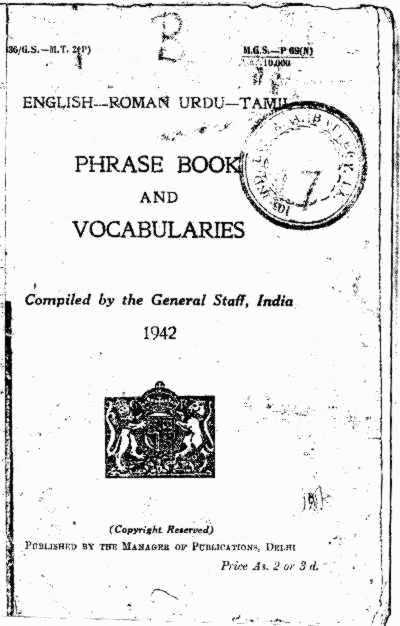
They also had their own Indian Officers (Subidhars and Jemidhars) and their NCO’s (Havildars and Naiks) who often acted as interpreters. British Officers were expected to speak Urdu, but the British Other Ranks were not compelled to learn any Indian language although they were expected to encourage the Indian troops to practice their English as much as possible. The outcome, of course, was that we found ourselves learning smatterings of several languages from the Indians themselves: the most common language amongst our Madrassies was Tamil but some spoke Telegu or Malayalam.


My second leave in India was taken in 1945, I can’t remember the month but it was probably early in the year, certainly before VJ day, which happened in August. We were stationed at Gulanchi near Poona and I went on leave with a fellow Sergeant from the same unit as me. We chose to go to Madras for our leave because we knew the town quite well and we were to meet his brother there who was on leave with the RAMC in India.


I must have spent three Christmases in India. The first one, which was in 1943, I remember very well, as we were stationed at Fort St George in Madras. I was a Bombardier in charge of the “Ack-Ack” Operations Room and on duty most of Christmas Day. I was relieved from my post to have lunch in the Sergeants Mess but my pre-lunch drink was doctored by my mess-mates and had the effect of spoiling the whole of my lunch. I awoke on my bed about five hours later having completely missed the Christmas celebrations. I’ve never been able to abide the smell of gin to this day.

My second Christmas, 1944, was probably also spent in the Madras area but I can’t recall exactly where we were. I was a Sergeant by then.
The Christmas of 1945 was something special: the war was now over, we had just celebrated VJ day and we all knew it was to be our last Christmas in India. We were stationed at Gulanchi and as the senior NCO of our group of British Other Ranks, I was appointed “President” of the Mess. Army tradition has it that at Christmas it is the duty of the Officers of the unit to serve up the Christmas Dinner and as this was our first peacetime Christmas we made sure the Officers did their job. I can’t remember what the food was, but we certainly enjoyed the occasion!

Note the barely-visible caption: “Destination 9th Raj”.