The Army Years.
1945-1946

It was 1945; the war in Europe was over in May. VE day was being celebrated everywhere, but in the Far East the battle to defeat the Japanese still continued. My unit, an Indian Artillery Regiment, was part of a Brigade stationed at Gulanchi. This was an enormous army camp situated in the hills about twenty miles outside Poona. We were involved in preparing our recently acquired new vehicles, guns and equipment for the final push into Malaya. Special training was carried out by the Indian troops and their British Officers and NCO’s. We were preparing for possible beach landings and consequently all the motor vehicles had to be modified and waterproofed.
August 17th 1945 brought the news that the war with the Japanese was over. The whole camp rejoiced as thousands of motor horns relayed the good news across the vast site. Within days, changes were taking place in everyday routine. Normal gunnery training continued in the camp, but all the British troops were invited to take part in vocational training in preparation for their impending return to civilian life.
Courses for the British troops were being organised, both inside the camp at Gulanchi and in other camps in the greater Poona area. I enlisted for a butchery course, which proved to be a farce…
The course was to be at a local abattoir run by the Indian Army Service Corps, just outside Poona. I was attached to a British Signals Regiment for the purpose of accommodation and used their Sergeants’ mess. When I reported to the abattoir for duty on the first day I discovered that they had not been advised of any course; they were also too busy to help me.
Only one man, an Indian NCO in charge of the office, showed any interest. He spoke good English and endeavoured to contact HQ to report my dissatisfaction. He suggested I spent my time wandering around the depot on my own and take notes if I wished. I consequently spent some time every day watching the slaughtering and preparation of the beef and the rest of my time in the office, sitting, watching and waiting. I had hired a bike from the Signals Barracks where I was staying, so was able to cycle into Poona in my spare time, which I seemed to have plenty of.


I was subsequently withdrawn from the “course” on my second week there, after I had complained to an Officer from my unit who I spotted in Poona whilst visiting a book-shop.
On returning to my unit at Gulanchi I wrote a full report for my Officer Commanding stating what a waste of time and effort the “course” had been, and although he sympathised and accepted the report, I heard no more about it. Two weeks later he asked me if I would like to take an Officer training course and sign on for another two years in India; I refused of course.
Mike says: Alf never quite went into detail about refusing a Commission, but it meant that he'd left India in 1946, before Partition and all that conflict, and that we did talk about.
In the meantime, other vocational training courses were being organised in the camp, at Gulanchi. Typing was one of the subjects I chose; I only attended a few lessons, but I learnt enough to know where the keys are! The teaching facilities were a bit primitive but we didn’t expect much better under the camp conditions. My typing course was brought to an abrupt halt when it clashed with another course which I was more keen on doing: driver training.
I was a complete newcomer to driving, as were most of my fellow trainees. About six of us reported to the MT depot on the camp and were taught the basic driving skills on a circular cinder track with no other vehicles around. We used a 15cwt Bedford army truck and were accompanied by a very helpful British army instructor. His job was to condense a normal six-month army driving course into about two or three weeks.
One of our Officers, who was organising the course, was to take us on our tests. Those that passed the test would get a army driving licence and this would allow them to drive a civilian vehicle without having to take another test, so naturally we were all keen to learn. In a very short time we were all able to drive around the cinder track on our own without supervision. We later progressed to driving on the main roads with the Officer in the passenger seat. On two consecutive Saturdays, he took six of us into Poona City for the day, each man taking a turn at the wheel while the others rode in the back of the truck. On the second week, three of the men were tested and passed OK for their licence.
It was to be my turn on the next trip to Poona but unfortunately the Officer who was testing us was posted back to Britain and consequently the course was cancelled. I did manage to persuade a fellow NCO to give me some driving tuition on the rough tracks inside the camp, and although I found this a very useful experience there was no chance of me taking another test.
Shortly after this I was called upon to drive a three-ton lorry in an emergency situation: a message was received in the camp that a new contingent of Indian troops had been posted to our unit and had arrived by train at Poona station where they were awaiting road transport. Every available driver was rounded up and I was ordered to drive this enormous empty truck, in convoy, in the middle of the night without a co-driver. The vehicle had no head-lights and poor brakes and it was very dark, but it was an emergency so every available vehicle had been forced into service. I just followed the lights of the vehicle in front of me and hoped for the best…
Poona was about twenty miles from the camp; the road was rough, narrow and winding and at times dangerously near the edge of the mountainside. Needless to say, I made it in one piece and breathed a sigh of relief when I arrived at the railway station. We rounded up our troops and I gratefully handed over the lorry to an experienced driver who drove the fully loaded vehicle back to the camp with me in the passenger seat, showing him the way.
About October 1945 I received a letter from my employer, Thomas Kingston, assuring me that my job would be waiting for me when I got back home to England, adding: “Would you please make it soon!”
Another activity, which was part of the Vocational Training Scheme, was the formation of a concert party group, recruited from some of the British army units on the site. About twenty people in all were involved, most of them Officers and NCO’s, a few having had amateur show-business experience and others opting to help backstage as electricians and carpenters, etc. An Officer in my unit, Peter Oliver, was a very good artist, so he was made responsible for designing and painting all the scenery and stage props; he asked me to be his assistant because of my experience in painting tactical signs, etc., on army vehicles. Another of the Officers was asked to write story lines and scripts, and he eventually produced and directed all four of the shows that we put on.
We staged our first show at the Forces’ Cinema on our camp at Gulanchi on 22nd October 1945. We used the cinema for rehearsals, and a spare room behind the stage to build and store all the scenery and props for the shows. We were very short of materials for props and costumes so we had to improvise a lot: the programmes were typed on to an “onion-skin” stencil and duplicated on to cheap flimsy brown paper (nevertheless, my copies of the programmes still survive after 50 years, but only just!).

The cast of the show called themselves “The Monsters” and the first show entitled “Without a Clue” was a review, a series of short sketches with some singers and stand-up comedy. We also managed to get a RAF band to help the show along. The show was acclaimed to be a great success, so much so that the Brigadier ordered them to stage a second show at the Forces Club in Poona, to be on 7th November 1945.
This attracted a much wider audience and the club was consequently packed out. This venue was ideal, as the building, previously used as a Civic Centre before the war, had been purposely refitted as a theatre with a large stage and dressing rooms. However, the change of venue caused problems for the backstage staff, who had to transport all the props, scenery and costumes, including the large stage curtains and back-drops, from the camp at Gulanchi to the theatre at Poona before the show and return them afterwards, a journey of about twenty miles each way.
On the success of the first two shows, a third performance was requested by a British field gun unit who were stationed a few miles outside Poona. We put the same show on for them, with local variations, on the 20th November 1945 and they supplied the “Gunners Band” this time. I was Assistant Stage Manager for this show and also for the following one at Christmas, in Poona, which was to be our last.

It was inevitable that our final performance should be a special Christmas Pantomime, especially that for most of the British Troops it was to be their last Christmas away from home. The pantomime, “Jack in the Q Stores”, was staged at the Forces Club in Poona and a great success it was.
My recollection of dates and places we visited in India is vague because we had little opportunity to keep records of our itinerary and on one occasion, we were ordered to destroy all personal letters and diaries for security reasons. Some of the events recorded here are recalled from old letters and photographs, etc., which I had sent home at the time and are now kept in memorabilia albums.

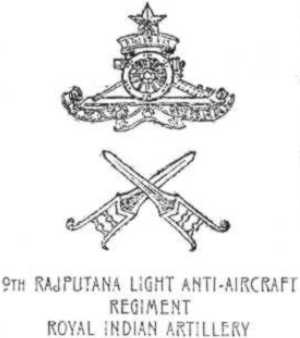
My last long journey across India was by road. Our regiment, the Ninth Rajputs, was being disbanded and the BOR’s integrated into a new unit, the Sixth Punjabs. Many of us had been with the old regiment for a long time and had travelled a long way together, so we decided to have an appropriate keepsake made. A talented fitter in our workshop fashioned for each of us a silver badge made from a rupee coin. The badge depicted crossed ceremonial ancient Indian swords, which was the official emblem of the Ninth Rajputana Light Anti-Aircraft Regiment, Royal Indian Artillery. I still have mine, 50 years on!

The long journey north started very early in the morning, we moved out in convoy from Gulanchi and it took a whole day for the Battery to leave the camp and if I remember correctly, about two weeks to reach our destination in the Punjab.

We obviously made several stops on the way and had some interesting experiences. We travelled through many towns and villages, some of which we had passed through before or had been stationed there. One such place was Agra. I had been through the town at least twice before by train, but this time we actually camped there, about two miles from the famous Taj Mahal. Although we were hoping to get a chance to visit the building, it wasn’t possible because of our travel schedule, and we didn’t even see it from a distance…
We also stopped at Delhi and at Lahore, both places I had been to before. We established a temporary headquarters at a smaller town called Wah, which I shall never forget because I remember being asked to paint our new regimental emblem on a concrete plinth outside the main office building. It was a drawing of an elephant, the Sixth Punjab’s regimental badge; I never did manage to get a badge for myself, but I did borrow one from an Officer in order to copy it for the emblem which I painted, which was about 4 feet high.

by Alf in April 1946.

At Wah, the BOR’s were invited to take up temporary membership at the social club of a local factory, the Punjab Cement Works. We paid our subscription (I still have my receipt) and were allowed to use their outdoor swimming pool, and that was where I learnt to dive, although I couldn’t swim very well (and still can’t). I also learnt to play snooker there.
We finally reached our destination, Mansar camp near Rawalpindi. I seem to remember there was very little left for the BOR’s to do; our duties were probably suspended whilst we were awaiting further orders. Maybe the Indian troops were on leave or elsewhere on an exercise, but most of the British lads, like myself, were awaiting repatriation.
We found the camp very clean and comfortable compared to some we had been in. A group of us would walk across the fields on most days to swim in the local river; a photo taken one day after the swim bears the names of some of the lads and the date – May 1946 – and this is in my photo album.

in May 1946. Back row from left: Gilbert, Roulston, Packer, Knowles, Pound, Ewings, Stevens.
Front row from left: Barnes, Slade, Thorton, Morris, Allen.
The town of Rawalpindi was not far away and we made regular Saturday visits there searching the shops for souvenirs to bring home. One purchase that most of us considered necessary was a large heavy leather suitcase with reinforced straps and buckles, plus wooden battens on the base for added protection, made to order at a local shop. My services were in great demand at the time to paint names on the suitcases, in “Old English”.
An essential part of our Saturday routine in Rawalpindi was to visit a Chinese restaurant for a meal and for some strange reason most of us would regularly order the same meal every week… eggs, steak, chips and tomatoes!
I was lucky with letters from home, from friends and relatives, they were great morale boosters. One of my regular writers was aunt Nell; she was also writing to my cousin George Woodgate, whom I only remembered as a child in Bermondsey. By coincidence, George was also serving in India at the same time as me and aunt Nell sent me his address.
The relaxed period at Mansar Camp offered an ideal opportunity to visit George once I had contacted him and discovered he was within travelling distance from Rawalpindi. His army barracks was near Peshawar, on the Northwest Frontier, about one hundred miles distance from Rawalpindi. About three of my fellow NCO’s at Mansar Camp wanted to come with me for the ride, so we got permission to borrow a small truck and set off early one Sunday morning.
That part of India (which is, of course, now Pakistan) was mostly remote countryside; the roads were little more than mud-tracks used by bullock carts and camels, and the only way to avoid getting stuck in the potholes was to drive fast. We went through several small villages and somehow our driver managed to avoid colliding with the many dogs that wandered across our path.
We found the barracks and met George in the NAAFI canteen, but the long trip was not complete without a trek up into the mountainous region to get a view of the famous Khyber Pass. The border was fenced off and guarded on the other side by an armed Afghanistan sentry. There was a small Indian traders’ hut on our side of the border; we had some refreshments there before setting off on our return journey, and I did manage to buy a Khyber Pass postage stamp from the hut as a souvenir (now, whatever happened to that stamp?).