
1978-2001. An afterword.
Some comments about Alf Allen’s life, living at Greenlea Crescent, Swaythling, Southampton.
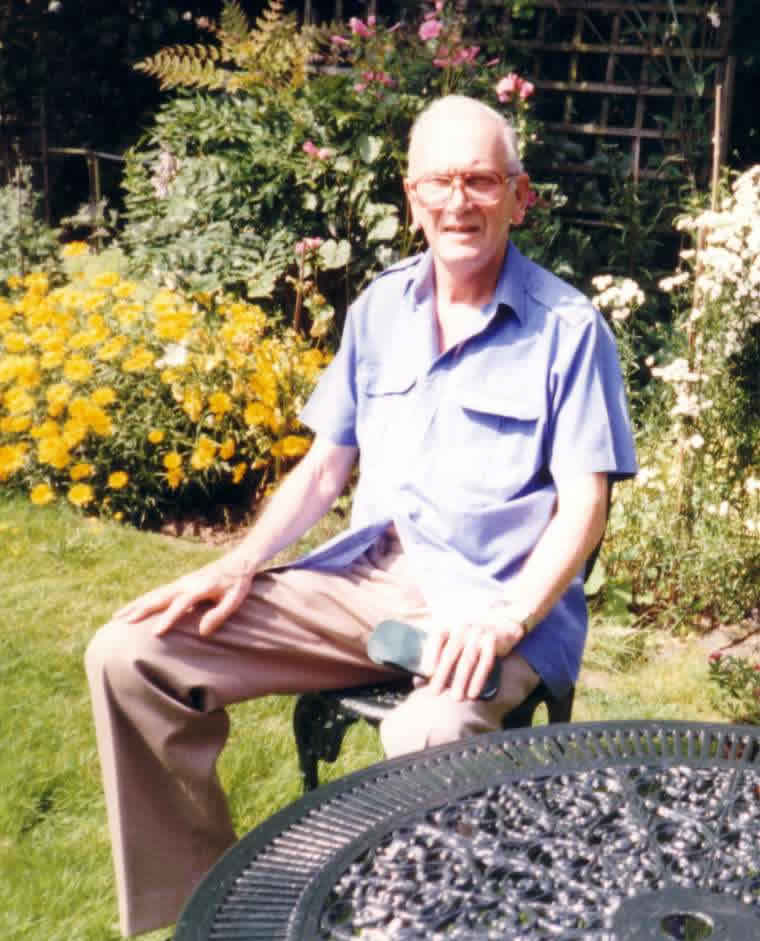
Mike Allen wrote in 2001:
This chapter of my dad’s life wasn’t in his written Annals; for some reason he stopped that flow of recollections as at 1978, when he moved into his furnished flat in Swaythling, Southampton. I find that surprising; it’s not only a fair portion – 23 years in a life of almost 80 – but it was some of the most interesting (to me, anyway). Whether he was happy is not for me to say, but he seemed mostly content. Married twice, divorced twice, but a man seemingly content in his own, and a few discreet others’, company.
But I guess he was thinking about writing a history, and thus what was happening as the present held less interest for him.
So, I had a go at writing this part, and I must tell you, it’s not easy… considering I’ve always written for work and for pleasure. It’s difficult writing someone’s life story for them, even a so-called chapter of it. And despite the fact that he was my father and in the years he spent in Swaythling I saw him regularly, I can’t adequately fill-in the gaps that exist.
The major problem is that I didn’t live with him, or see him often enough – OK, I visited several times a year, but during the time I was married to my first wife, she wasn’t that enthusiastic about Alf and his ‘irascible’ ways… and I didn’t make enough effort to see him, to get to know him. Yes, yes, it’s the same that occurs to any of us that lose someone we love – always too late to find out more.
Maybe I shouldn’t deem myself suitable to add anything; he had, after all entitled the printed work “MY FAMILY HISTORY ANNALS (from Southwark to Southampton) A DIARY OF EVENTS from pre-1900 to 1978”.
Maybe a diary of his events it should remain.
The fact that I feel there should be more is only because I miss him (and still do when revising this in 2026).
In the end, I’ve decided that I can only try to offer some comment on what my dad wrote before, add a piece here and there to describe how I saw him. Somewhere there existed his final journal, a day-by-day account of his non-diagnosed illness with oesophageal cancer and his increasing terrible loss of weight, but I would not want that here, and know for certain, neither would he!
From the chapters above it is plain to me that he marked his life increasingly, after his first marriage to my mother ended, with his diary entries: sometimes mundane, but a record nonetheless.
I saw many times (and my first wife commented) that he often tended to measure his life away…
He sometimes gave to others the outlook of a much older man, but was still mentally and physically fit right up until the end: whenever I visited he would walk his usual daily three to five miles, only desisting when the rain was heavy, and often wore me out as someone thirty-two years his junior.
His greatest stated happiness was clearly during his army years, although he seemed to enjoy his retirement, too.
The single chapter of his book, about his army years that has become 1941-England, 1943-India, 1945-India and 1946-England, is (obviously) the longest, most detailed, most interesting to me and he could be persuaded to talk about those years in India at length, although I can never remember more detail than he put in here.
Of course, it’s a shame that he didn’t include anything in his Annals from 1978 onwards, as his life did change, expand, broaden. His work at British Aerospace was of great interest and pride to him: he told me many times of his inspection of parts for Harrier Jump-jets and Hawks, and that the Red Arrows Aerobatics Team relied on the quality of “his” factory’s output.
He was pleased with the social life attached to the factory in Hamble, which paralleled his contribution with Plessey, although he never became as formally involved with British Aerospace; he was 57 when he joined them. And he made good friends, amongst them Bill Brown, whilst working there that he kept afterwards when he retired.
Indeed, Bill was with him as a good friend and driver – Alf never did properly learn to drive nor pass his test – right to the end. Bill was genuinely angry that my dad hadn’t been given the best treatment by his local doctor and that by the time he got to hospital on the 2nd February 2001, it was too late.

He looks happy – I think he must have thought that I’d never get married (I was 36 years old, so maybe so did I…). His mother, my grandmother, Florence Hobbs, was also present, but I’ve not found any pictures of her taken there.
It’s a shame neither of them were alive for my second marriage to Dr Melissa Lee Price in 2004, although his brother, Fred, and wife Dorothy, were there.

2001. Some final words:
Of course, those of us that believe wholeheartedly in synchronicity (and don’t ask me to define that here…) will smile sadly at the following.
On the day my dad had his central line fitted, even as the hospital staff were putting it into his neck to feed him, I went downstairs and bought a copy of the Guardian newspaper from the hospital shop. In that day’s edition was this:
What Works? The definitive guide to treating common ailments
No 31: Cancers of the stomach, oesophagus and pancreas.
Almost one in 10 cancers strike the upper gastrointestinal (UGI) system (the stomach, oesophagus or pancreas). Most sufferers are elderly, although younger people are occasionally affected. Prognosis is generally poor – only about a quarter of UK patients survive a year after diagnosis. International studies show better survival rates elsewhere.Diagnosis
Early diagnosis is difficult. Typical symptoms – such as dyspepsia, nausea and stomach pains – are common to many other, less serious, complaints. Government guidelines stipulate patients should have investigations within two weeks if they show symptoms including jaundice, dysphagia (when foods sticks on swallowing), or dyspepsia, when combined with other warning signs such as weight loss or family history of UGI cancer. Anyone with suspected oesophageal or stomach cancer should have an endoscopy; ultrasound is best for suspected pancreatic cancer.Treatment
For stomach cancer, the UK’s five year survival rate of 12% is almost half the 21% European average. Later diagnosis and poorer hospital care seem to be key reasons. A major study of UGI cancer care in 29 hospitals in England and Wales found doctors who saw more patients had lower death rates. The trend is confirmed in US studies. Surgery to remove the cancerous area is the main treatment when cancer is diagnosed early enough, but it is risky. Patients often die within one month. A large study has shown that chemotherapy before surgery for oesophageal cancer improves survival by 10% after two years. Combining chemotherapy with surgery for stomach cancer has a slight benefit, according to analysis of several studies. Radiotherapy seems to help only a minority of patients with oesophageal cancer. For most people, palliative care to relieve symptoms is the main need. Inserting metal tubes can help swallowing.Wendy Moore
What works? is based on reviews of the most up-to-date and reliable evidence available. It is written in collaboration with the NHS Centre for Reviews and Dissemination at York University and verified by experts. Details can be seen on the CRD website www.york.ac.uk/inst/crd
©2001 Guardian Newspapers
And finally, here’s something I can across in 2001, soon after my dad died, that brought it all home to me – we’re all the same, eh?
What Would We Find in Your Boxes – By Jim R. Warda
Since my dad died, my family has been going through his boxes, organizing the life he left behind. And with each opened box, I learn more about him.
More about his passions, like poetry, music, and flamenco dancing.
More about his compulsions, like keeping documents, no matter how unimportant, for over forty years.
More about his caring, like letters sent from clients, thanking him for being there through difficult times.
More about how he loved us. Because in those boxes were cards we’d given him throughout his life and remembrances of his children’s achievements.And, it was then, standing silent over those boxes, as tears and dust mixed upon my face, that I wondered what my children would find in my boxes when I’m gone.
Would they puzzle over the clothes that I used to wear on stage when I played in a rock band?
Would they argue over who would keep the blue Plexiglas peace sign I bought at a garage sale?
Would they be amazed at how many pictures I had of their mom?
Would they remark at how odd it was that I loved reading, writing, and music, just like my dad?And, most of all, as they looked at the stories I’d written, would tears and dust mix upon their faces as they realized how much I loved them?What will be in your boxes?
By Jim R. Warda
Sheed and Ward © 2001. All rights reserved.
Mike says – found in my dad’s boxes:
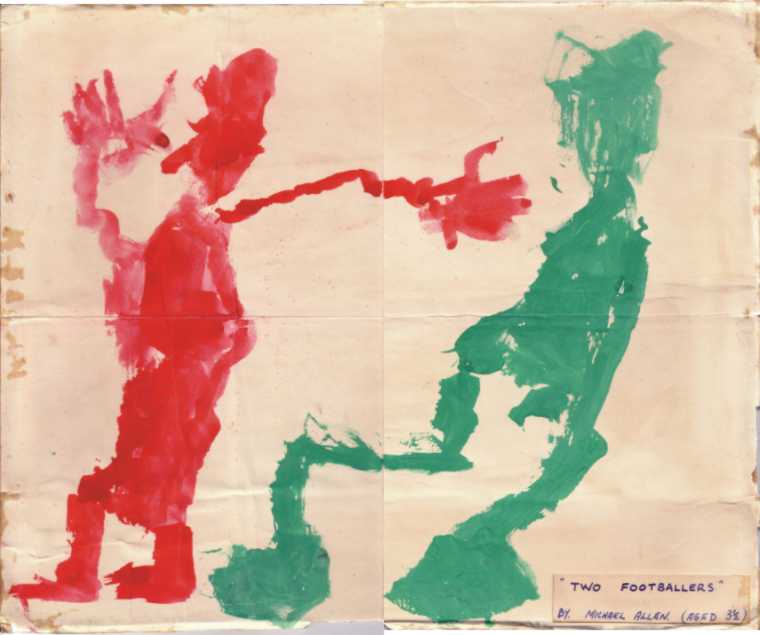
Painted (OK, OK, daubed…) by Michael Allen on 7th May 1957. I was 3½.


My spelling may have improved (and the advent of the spell-checker has aided that, too) but you’ll see my writing hasn’t. I type a lot.
I don’t have a date for this, but I suspect it’s also late 1950’s.
It’s painted on a cardboard insert that used to feature in Shredded Wheat boxes.
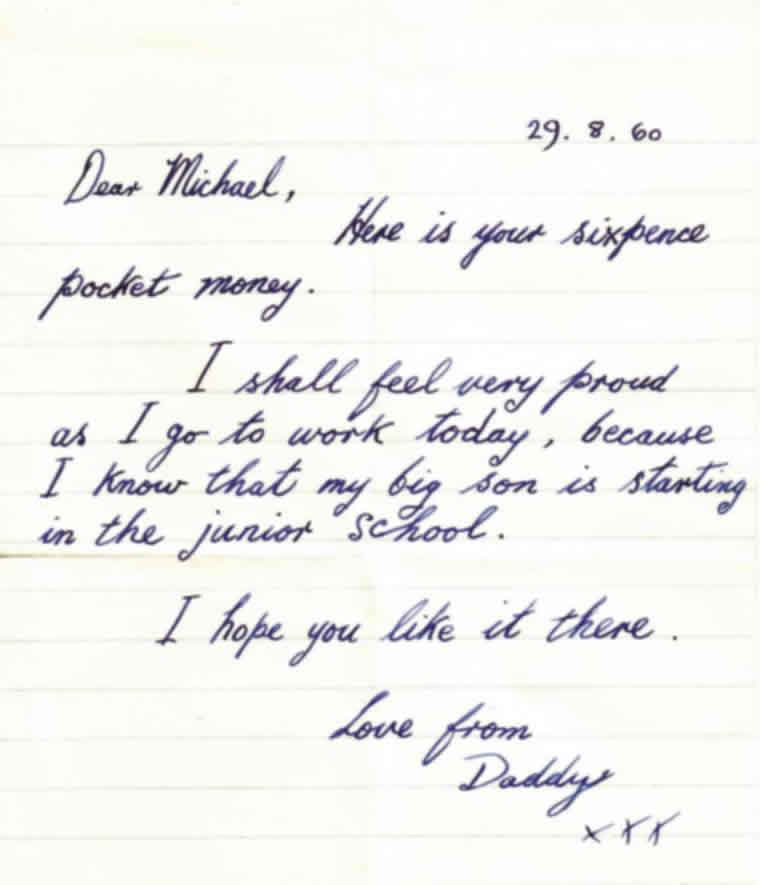

OK, it’s the best of the bunch – another report from March 1961 shows me coming 25th out of 46, rather than 1st as here.
All you teachers: – note the class size of 45.
The “group” of 123 was total number of pupils in that age-range in the school – the year size. That was us Boomers! OK?